Pirkei Avot Course - Register near bottom of the page
Pirkei Avot (Ethics of the Fathers): The Big Picture
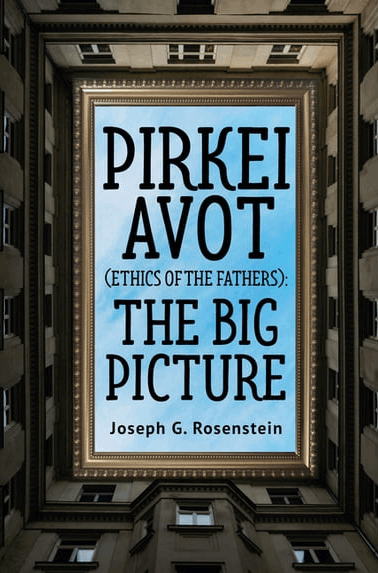
Published by: Academic Studies Press
Purchase a paperback copy of the book for $56
(including shipping within the US)
This book is published by Academic Studies Press, and hardbound and electronic copies, and copies shipped outside the US can be purchased at its website
https://www.academicstudiespress.com/9798897831432/
Go to https://youtu.be/aoaHAvT30jA for a recording of the author describing his book more fully at a “virtual book launch” that took place on August 13, 2026.
Pirkei Avot consists of teachings initially assembled c. 200 ce, a small part of the Mishnah, a compilation of Jewish practices necessitated by the destruction of the Temple in 70 ce. Ethical issues play such a large role in Pirkei Avot that early translators called it Ethics of the Fathers.
In Pirkei Avot, one teaching typically is unrelated to the next teaching; the same is true in almost every commentary. Because the 123 teachings in Pirkei Avot are not arranged by topic and often appear unrelated to one another, its broader conceptual framework—the “big picture”—can easily be overlooked.
Pirkei Avot: The Big Picture addresses that challenge by approaching Pirkei Avot thematically. It examines key topics, including the Oral Torah, the world to come, the study of Torah, and a range of ethical concerns. It focuses on the thematic connections in Pirkei Avot and provides a narrative flow that readers will find valuable. It offers readers a clearer sense of structure and a more coherent understanding of Pirkei Avot as a unified work.
- Pirkei Avot: The Big Picture focuses on the major themes of Pirkei Avot, including the oral Torah, the world to come, the study of Torah, and ethical issues
- Unlike other commentaries, it does not discuss the mishnayot (teachings) in the order in which they appear; instead, it connects and discusses together mishnayot that have a common theme even though they are not near to each other in the text of Pirkei Avot
- It discusses the major developments in Judaism in the generations following the destruction of the Temple and Jerusalem, as they are reflected in Pirkei Avot
- One major focus of the book is on ethics; in this extended chapter, the general non-directive statements in Pirkei Avot are converted into 90 action-oriented ethical principles
- The 90 ethical principles are divided into 16 coherent groups and the essay discussing each group ends with a kavvanah (short meditation) to assist readers who intend to implement the ethical principles in that group in their own lives
- Foreword
- Pirkei Avot: The Big Picture
- A Guide to the Reader
- Preface
- Acknowledgements
- Dedication
- Introduction
- Transliteration Alert
- Pre-Mishnah Timeline
- Background to the Mishnaic Era
- Four Important and Particularly Relevant Biblical Verses
Part I. Major Themes
- Chapter 1: Commitment to the Oral Torah
- Chapter 2: The Importance of Torah Study
- Chapter 2A. Balancing Torah Study, Work, and Good Deeds
- Chapter 3: Belief in Olam Haba (The World to Come)
- Chapter 3A. Rewards in Pirkei Avot
- Chapter 3B. Punishments in Pirkei Avot
- Chapter 4: The Ethical Principles in Ethics of the Fathers and Our Task of Incorporating Those Principles in Our Lives
- Table of Contents for Chapter 4
Part II. Additional Themes
- Theme 1: Sages, Be Careful of What You Say!
- Theme 2: Our Relationship to God
- Theme 3: Honor and Humility
- Theme 4: Anger
- Theme 5: Judges and Justice
- Theme 6: Free Will and Super-Omniscience
- Theme 7: How Pirkei Avot Addresses Some Contemporary Issues
Part III. Editorial Issues
- Issue 1: Who Wrote Avot?
- Issue 2: Where is Rabban Gamliel?
- Issue 3: How Many Is Ten?
- Issue 4: The Use of Proof-Texts
- Issue 5: What Happened with Avot after Its Completion?
Part IV. Fifteen Interesting Questions
- A. Why Are Additional Mishnayot Recited before and after Each Chapter of Pirkei Avot?
- B. Why Are We Told, “When Your Enemy Falls, Do Not Rejoice!”?
- C. Is Shammai as Bad as His Reputation?
- D. How Is God Referred to in Pirkei Avot?
- E. Is Our Covenant with God Still in Effect?
- F. What Are Ben Zoma’s Four Questions?
- G. Why Do Good People Suffer and Bad People Thrive?
- H. Where Do Our Defenders and Prosecutors Live?
- I. When Does Judgment Take Place?
- J. Why Is It Dangerous for a Scholar to Stop and Smell the Flowers?
- K. What Biblical Figures Are Mentioned in Pirkei Avot?
- L. What Are David and Jonathan Doing in Pirkei Avot?
- M. Where Is the Temple Discussed in Pirkei Avot?
- N. What Are the Stages of a Person’s Life?
- O. What Inconsistencies Are There in Pirkei Avot?
Part V. Appendices
Table of Contents for the Appendices
- 1. The Text and Translation of Pirkei Avot
- 2. Glossary A: Jewish Texts
- 3. Glossary B: Jewish Prayer and Practice
- 4. Teachers of Pirkei Avot (including Alphabetical List of Teachers)
- 5. Memorize These Phrases!
- Bibliography
- Indices
“The Ethics of the Fathers is a gem of rabbinic wisdom. In this groundbreaking book, Professor Rosenstein offers readers a way to appreciate it as never before. By illuminating its central themes, he transforms this classic from an anthology of ethical aphorisms into a coherent body of profound ethical teaching. His crystal-clear writing and inviting tone deliver a wealth of insight effectively and enjoyably. Rosenstein strikes an exquisite balance between academic rigor and personal style. Delve into this book, and you will discover not only why Pirkei Avot is perhaps the most widely read rabbnic text, but also how it can deepen your intellectual and spiritual life.”
– Daniel Matt, translator of the Zohar, author of The Essential Kabbalah, God and the Big Bang, and Becoming Elijah
“I have had the opportunity to follow the growth of this book over the years. Despite methodological differences in our approach, Pirkei Avot: The Big Picture is a consistently learned and thought-provoking work of scholarship. It is highly recommended for anyone interested in this fascinating tractate of the Mishnah.”
Azzan Yadin-Israel, Professor of Jewish Studies and Classics, Rutgers University
“Joseph G. Rosenstein’s Pirkei Avot (Ethics of the Fathers): The Big Picture is a deeply insightful guide to this ancient and enduring text. With clarity and intellectual precision, Rosenstein extracts profound meaning and demonstrates its continued relevance in the contemporary world. His unique organizational approach does more than explain individual sayings—it illuminates the core values that unify them, helping readers see the ethical system as a coherent whole. Even after years of studying and teaching Pirkei Avot, I found myself discovering new insights and connections I had never recognized before. The result is both accessible and sophisticated, inviting newcomers and experienced learners alike to engage more thoughtfully with the text. This work stands out as a meaningful bridge between timeless wisdom and modern life, offering readers not just interpretation, but perspective.”
– Rabbi Andrew Warmflash, Rabbi Emeritus of Hewlett-East Rockaway Jewish Centre, East Rockaway, New York.
“One need look no further than Joseph Rosenstein’s exhaustive study of Pirke Avot: The Big Picture to find a wide-ranging overview of the core principles of Judaism. Using this ancient book as a scaffold, the author explores rabbinic Judaism, providing both ancient and contemporary contexts for its fundamental teachings about Jewish ethics, theology, history, and principles. Comprehensive, clearly written, and particularly relevant to our times. Useful for teachers, students, and seekers.”
-Ellen Frankel, author and former Editor of the Jewish Publication Society
“Big pictures hold many details. To produce this “big picture,” Dr. Rosenstein has masterfully assembled points of history, ethics, disagreement, and endurance to present his “Big Picture.” His monumental work offers the reader the opportunity to ingest this large serving of Jewish learning called Pirke Avot as a key source of guidance for living an ethical Jewish life. This scholarly yet eminently accessible work affirms the need to understand the context in which these “fundamental principles” were developed in order for succeeding generations to extract the applicable wisdom of the sages. PIRKE AVOT: THE BIG PICTURE is a gift that grants keys to ideas that lift the spirit and guide behavior.”
– Rabbi Ted Feldman, Rabbi Emeritus of B’nai Israel Jewish Center, Petaluma CA
“As an educator of adult learners, I find Joseph Rosenstein’s The Big Picture an exceptional resource for teaching Pirkei Avot. By organizing its teachings into clear, thematic sections, Rosenstein presents a traditionally complex text in a way that is accessible, engaging, and
highly relevant to contemporary audiences. His commentary skillfully weaves together classical sources, Jewish history, and modern ethical challenges, demonstrating the enduring power of these teachings with both candor and respect. Enriched with insights into language, tradition, and culture, the book enhances Jewish literacy while fostering
meaningful class discussion and personal reflection. Rosenstein’s scholarship is both thoughtful and approachable, as he unpacks complex ideas without losing sight of his central goal: to elevate Judaism’s ethical core and inspire readers to live its values. The Big Picture is an outstanding text for guiding today’s adult classroom through a thematic,
rather than strictly sequential, study of Pirkei Avot.”
– David Strassler, President and spiritual leader of Temple Etz Chaim, Biddeford Maine
Here are some questions that I raise, discuss, and try to answer in Pirkei Avot (Ethics of the Fathers): The Big Picture, questions that, to the best of my knowledge, are not raised or discussed in other books about Pirkei Avot. (The questions are not presented in any particular order.)
- Why does no teaching of Rabban Gamliel II appear in Pirkei Avot?
- What motivated Shmuel haKatan to repeat a phrase from Proverbs that says that you should not rejoice when your enemy falls?
- How many is ten; that is, when ten is mentioned, does it mean exactly ten, or about ten, or at least ten?
- Who likely originated the blessing that we recite before studying Torah?
- Whose teaching motivated introducing the verses said before Birkat haMazon if three people are in attendance?
- Who introduced the notion that God is super-omniscient, knowing not only everything that happens, but also everything that is going to happen?
- Why were special teachings recited before and after studying each chapter of Pirkei Avot?
- Who was involved in assembling each portion of Pirkei Avot?
- Who introduced proof-texts and which proof-texts in Avot actually help substantiate the text they are trying to “prove”?
- How are the tragedies of the destruction of the Temple and Jerusalem and the failure of the bar Kochba revolt reflected in the teachings in Pirkei Avot?
- How did the notion of olam haba (the world to come) change between the time of Hillel and the completion of Pirkei Avot 200 years later?
- What are the rewards for studying Torah?
- Why is Elisha ben Abuya mentioned by name in Pirkei Avot although elsewhere his teachings are always attributed to “acher (that other guy)”?
- How can one translate the general ethical teachings in Pirkei Avot into imperative statements, ethical principles, that tell us how we should behave?
- What are the main themes of the ethical principles that emerge from Pirkei Avot?
- What problems arose as a result of the new emphasis on the study of Torah, and how were these problems resolved?
On pages 67-68, there is discussion of the thrice-mentioned Biblical prohibition, “do not boil a kid in its mother’s milk.” It should be noted that some scholars feel that this is a mistranslation of “al t’vashel g’di bachaleiv immo.” For example, Stefan Schorch notes that the phrase “bachaleiv immo” does not modify the verb “boil,” as it is customarily translated, but instead modifies the noun “kid.” That is to say, the prohibition should be translated as “do not boil a kid [that is still] in [i.e., suckling] its mother’s milk.” Schorch does, of course, provide a rationale for that translation. If that was actually the original meaning of the phrase, then much of our Kashrut customs would be based on a faulty translation. See Stefan Schorch, “Do Not Cook a Kid Still Suckling Its Mother’s Milk” TheTorah.com (2022). https://thetorah.com/article/do-not-cook-a-kid-still-suckling-its-mothers-milk
On page 165, at the end of the first full paragraph (line 9 of the page), I would add the following: It may be that by the middle of the second century, the rabbis had realized, as is evidenced by the teaching of Rabbi Elazar of Modiin (see page 147), that all righteous people would have a place in olam haba, and so they were careful not to say that the rewards for studying Torah would be olam haba; that would not provide an incentive for studying Torah since all righteous people would already have that reward.
On page 235, near the bottom of the page, it says, “There is a similar maxim, often attributed to Native Americans, that you should not judge a person until you have walked a mile in their moccasins.” That attribution is not correct. The following is more accurate:
Although this maxim is often attributed to Native Americans, its origin is apparently the 1895 poem “Judge Softly” by the American writer and suffragette Mary T. Lathrop (1838-1895). The initial stanza of the poem reads, “Pray, don’t find fault with the man that limps,/ Or stumbles along the road./ Unless you have worn the moccasins he wears,/ Or stumbled beneath the same load.” The phrase “Walk a mile in his moccasins” acts as a refrain in the poem and, as a result, is often cited as the title of the poem. Perhaps she was familiar with Mishnah 2:5.
On page 270, I say that “the Mishnah insists in Tractate Sanhedrin 10:1 that anyone who does not believe that life after death is from the Torah is to be regarded as a heretic.” That is not quite correct. The sages generally did not try to legislate beliefs. A more accurate translation would be that “anyone who states that life after death is not from the Torah is to be regarded as a heretic.” That is, you only lose your place in olam haba if you publicly deny that it is from the Torah, but not if you just believe that it is not from the Torah.
On page 298, footnote 328, I should have presented the evidence for my statement that Rabbi Eliezer ben Horkanos was suffering from dementia. In Avot d’Rabbi Natan 25:3 it notes that, while Rabbi Akiva was waiting in the foyer, “His son Hyrḳanos went in to remove his father’s tefillin [since Shabbat was approaching], but he would not allow him to do so. Hyrḳanos came out weeping and said to the Sages, ‘My masters, it seems that my father’s mind is deranged (nit∙r’fah da∙a∙to shel ab∙ba)’. [Thereupon Rabbi Eliezer] called out, ‘My son, it is not my mind that is deranged but yours!” That was the beginning of Rabbi Eliezer’s moment of “terminal lucidity.”
On page 439, the first paragraph provides a statement by Rabban Gamliel in defense of his behavior. The following describes the circumstances in which he made this statement. On tractate Bava Metzia 59B, after discussing the controversy over the oven of Aknai (see pages 440-441), it is noted that Rabban Gamliel made this statement when he was in a boat that was sailing in a severe storm that, according to Rabban Gamliel, was generated by Rabbi Eliezer ben Horkanos. After he made this statement, which provided justification for his treatment of Rabbi Eliezer, God caused the storm to subside. But Rabbi Eliezer’s anger apparently did not subside. For Bava Metzia 59B then tells us that Rabbi Eliezer’s wife, Imma Shalom, was Rabban Gamliel’s sister, and she was afraid that, because of his anger at Rabbi Gamliel’s rebukes of him, her husband could bring about her brother’s death. She therefore distracted him each morning so that he could not pray for that to happen at the end of the morning prayers. One morning she failed to distract him, and on that very morning Rabban Gamliel died. The Talmud ascribes superpowers to some of the sages. (Posted September 19, 2026)
Pirkei Avot Course:
Registration is now open for my eighth course, a new zoom course — Pirkei Avot: The Big Picture – in which we will focus on the themes of Pirkei Avot, instead of studying the text as it is usually done, chapter-by-chapter and mishnah-by-mishnah.
There are no prerequisites for this course … other than an interest in learning about Judaism and its history … and its ethical teachings.
The course will have six sessions, all from 5:30pm to 7:00pm (Eastern time) on the six consecutive Sunday evenings between Pesach and Shavuot, from May 2 to June 6, 2027. There will be a fee of $90 per participant. Those who register before April 1 will receive a 30% ($27) refund.
Register now because the number of participants will be limited.
To register for the course, click on "Add to Cart" just below.
Speaking Engagements:
Joe Rosenstein conducted a virtual book tour at a dozen sites in the months following the publication of his book. He is now available to speak and respond to questions (either in person or remotely) about Pirkei Avot — either a single session or a multi-session course. A list of speaking engagements (including those in the virtual book tour) can be found here
View a recording of the May 3, 2022 event on YouTube – https://youtu.be/mOkm4vsHm1A